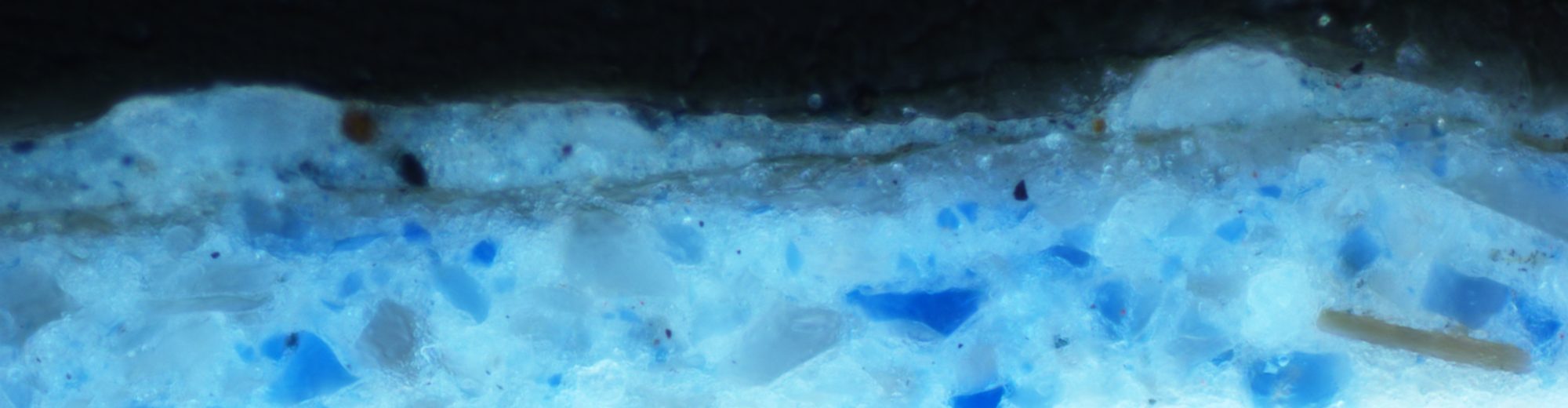
A major part of my research, initiated when I was working in The Netherlands in the groups of Joris Dik (TU-Delft) and Katrien Keune (Rijksmuseum – UvA), focuses on the crystallization mechanisms occurring within oil paint layers, that can lead to the in situ formation of organometallic complexes and non-original mineral phases. The formation of these compounds can have a significant effect on the visual integrity of paintings.
This research was notably conducted via the analysis of lead-based paint formulations by Rembrandt (1606–1669) and Leonardo da Vinci (1452-1519). The composition and microstructure of these formulations were studied through a combination of structural (synchrotron-based XRPD) and molecular (µFTIR) probes. This enabled the charting at the micro-scale of neo-formed metastables compounds, fingerprints of the historical recipes used by the painters. Hypotheses on the chemical reactions at stake were then proposed.
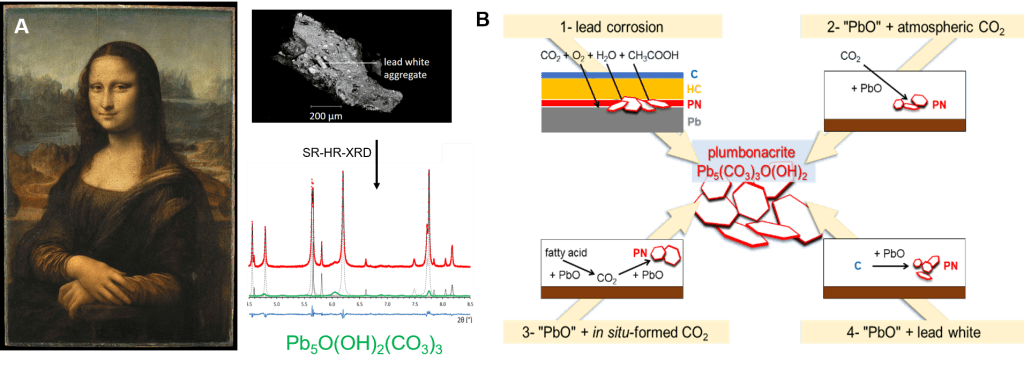
In this context, I am today particularly interested in the reactivity of lead oxides pigments in organic oil matrices: I study the chemical reactions at play at the level of individual pigment particles within an organic linseed oil matrix, in order to shed light on the transport mechanisms explaining the distribution at the micro-scale of newly formed compounds in paint layers.
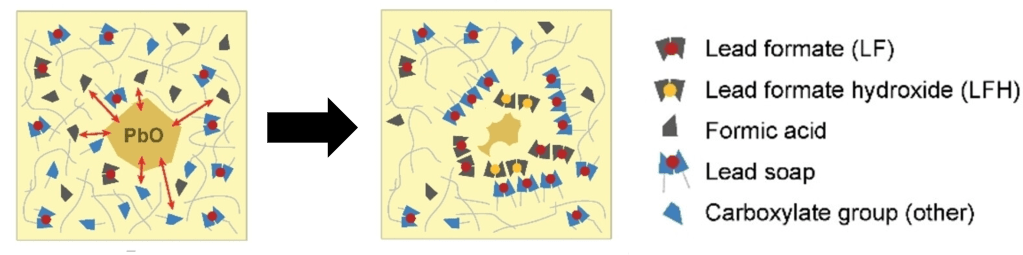
Finally, since my recruitment in 2023 as a CNRS Researcher, I have been particularly interested in the links between the mesoscopic organization of oil-based pictorial formulations and their reactivity over time. I try to use innovative highly sensitive and selective molecular probes to gain a better understanding of the chemical mechanisms involved in the alteration of these complex composite systems.
 Victor Gonzalez